Malm, A. (2021). How to blow up a pipeline: Learning to fight in a world on fire. Verso.
The science on climate change has been clear for a very long time now. Yet despite decades of appeals, mass street protests, petition campaigns, and peaceful demonstrations, we are still facing a booming fossil fuel industry, rising seas, rising emission levels, and a rising temperature. With the stakes so high, why haven't we moved beyond peaceful protest?
In this provocative manifesto, climate scholar Andreas Malm argues that the climate movement should consider revolutionary change. Drawing on historical social movements and political struggles, he examines the role that disruptive tactics have played in achieving major societal change. Through discussions of climate activism, political strategy, ethics, and social transformation, Malm explores how movements respond when faced with an escalating environmental crisis.
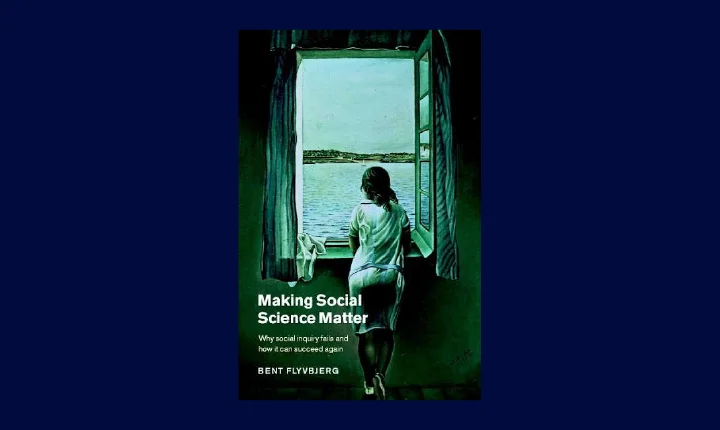
Flyvbjerg, B. (2001). Making social science matter: Why social inquiry fails and how it can succeed again. Cambridge University Press.
In the era of rising attention to social impact, can we really make something to turn social sciences like management into ‘socially impactful’ and ‘relevant’ disciplines? For much of the twentieth century, the social sciences sought to emulate the natural sciences, aspiring to produce universal theories and predictive models of human behavior. Yet despite significant advances in research and methodology, many social scientists continue to grapple with a fundamental question: how can social inquiry remain relevant to the real-world challenges faced by citizens, policymakers, and communities?
In Making Social Science Matter, Bent Flyvbjerg argues that the strength of the social sciences lies not in prediction, but in their ability to illuminate values, power relations, and practical judgment. Challenging conventional approaches to research, he proposes a vision of social inquiry grounded in context, experience, and what Aristotle called phronesis—practical wisdom. Through a compelling examination of methodology, ethics, politics, and social change, Flyvbjerg offers a powerful case for a more relevant and impactful social science.

Fligstein, N., & McAdam, D. (2012). A theory of fields. Oxford University Press.
Finding ways to understand the nature of social change and social order-from political movements to market meltdowns-is one of the enduring problems of social science. A Theory of Fields draws together far-ranging insights from social movement theory, organizational theory, and economic and political sociology to construct a general theory of social organization and strategic action. In a work of remarkable synthesis, imagination, and analysis, Neil Fligstein and Doug McAdam propose that social change and social order can be understood through what they call strategic action fields.
They posit that these fields are the general building blocks of political and economic life, civil society, and the state, and the fundamental form of order in our world today. Similar to Russian dolls, they are nested and connected in a broader environment of almost countless proximate and overlapping fields. Fields are mutually dependent; change in one often triggers change in another.
At the core of the theory is an account of how social actors fashion and maintain order in a given field. This sociological theory of action, what they call "social skill," helps explain what individuals do in strategic action fields to gain cooperation or engage in competition. To demonstrate the breadth of the theory, Fligstein and McAdam make its abstract principles concrete through extended case studies of the Civil Rights Movement and the rise and fall of the market for mortgages in the U.S. since the 1960s. The book also provides a "how-to" guide to help others implement the approach and discusses methodological issues.With a bold new approach, A Theory of Fields offers both a rigorous and practically applicable way of thinking through and making sense of social order and change-and how one emerges from the other-in modern, complex societies.