Ever richer tenants: the paradox of the rent burden
Jose Garcia Montalvo, Jorge Galindo
19 March 2026
When it comes to a differential diagnosis of the problems of the housing market in Spain relative to the international context, we stand out negatively for the high overburden in market-rate rental borne by citizens in the lowest deciles of the income distribution, which is consistent with the overwhelming shortage of social rental housing.
This, which places us at the bottom of every international ranking, has been wrongly attributed to the existence of large landlords controlling rental prices, when all the empirical evidence (Khametshin et al. 2024 estimate that only 8% of rental dwellings are in the hands of legal entities) indicates that they hold a very small share of a highly atomised market in which almost 2.5 million citizens report rental income from property to the tax authorities. Once this mistaken diagnosis had been established, the next step was to propose the textbook solution for when there is monopolistic control (that is, a single supplier) of a market: rent control.
The economic literature is very clear on the effect of rent caps when there is no monopolistic control of the market. Empirical studies on the impact of rent caps show that they do not work as their advocates argue. The meta-analysis by Kholodilin (2024) shows that all but one of the published studies find a negative impact on supply. All of the studies analysed show a misallocation of dwellings, and the great majority show an increase in rental prices in uncontrolled areas, as demand shifts there in response to the lack of supply in controlled areas. But without doubt the most influential study, given the quality of its methodology and data, is Diamond et al. (2019) on the case of San Francisco. This study shows that in the very short term rent control reduced mobility and moves out of San Francisco. In the medium and long term it caused a 15% reduction in supply, an increase in prices (5.1%) and an acceleration of gentrification through the sale of controlled units to very high-income families, the only ones who could afford to buy, which ended up pushing out the middle and upper-middle class who could have rented.
Despite the absence of signs of cartelisation in the rental housing market and despite the empirical evidence, the Housing Law approved the possibility for municipalities and autonomous communities to apply rent caps. In Catalonia they have been applied in two periods. The first period of price caps (Law 11/2020) lasted from 22 September 2020 to 10 March 2022, the date of Constitutional Court ruling 37/2022, which declared the essential provisions on rent containment unconstitutional. Under the cover of the Housing Law, the second period of rent control began on 16 March 2024. Monras and Montalvo (2023) show that rent caps in Catalonia caused a significant change in the composition of rental dwellings in the areas declared stressed, as well as a reduction in new contracts.
The latest data on rental deposits lodged show signs that rent caps are not working as a mechanism to improve access to rental housing. First, rental prices per m2 are rising again (mainly because of a composition effect described in Monrás and Montalvo, 2023), as was already observed in other cities where the downward effect on rental prices was short-lived. But the effect on supply is more important. Some interpreted the fall in new contracts as simply reflecting the longer duration of contracts. However, the data for the third quarter of 2025 on the net balance of contracts show a fall in the city of Barcelona, as happened in the third quarter of 2024. For some time after rent caps were approved, their supporters argued that the net balance of contracts was still growing, which showed that the policy had not affected supply. However, although in some quarters it did not fall, the net balance was substantially lower than before the rent caps were approved. The net balance of contracts relative to new contracts collapses with the application of the caps in the municipalities in stressed areas, while it holds steady in the control areas.
Nevertheless, deposit data have serious problems as a reliable source of information for impact analysis and evaluation. First, the prices are questionable. When price controls are imposed on a market, a black market appears. Many transactions will take place at prices above those set by the regulation, given that both landlords and tenants are willing to contract at those prices. If this is the case, and the hiring of a large number of inspectors is proposed to ensure that maximum prices are not breached, what happens is that the deposits lodged are artificially adjusted to the maximum prices.
Second, not all housing deposits are lodged, so the level of coverage of the data is unknown. It is not known what proportion of deposits are lodged in Catalonia, although it is assumed that more are lodged than in other autonomous communities. Moreover, policies endogenously change the propensity to lodge deposits: for example, if the risk-adjusted financial and tax return on regular contracts falls, landlords may prefer tenants on seasonal contracts or convert fraudulent regular contracts (used to take advantage of the tax deduction) into seasonal contracts. There is a legal obligation to lodge a deposit for this type of contract too, but in practice only a small proportion of deposits in this type of rental are lodged.
Data from the Spanish Tax Agency show significant differences in the number of active rental contracts compared with the deposit data from Incasol. The Tax Agency data indicate that the total number of rental contracts in force in Catalonia has been growing more slowly than in any other autonomous community since rent caps began to be discussed. In 2023, the latest year available, only in Melilla was the cumulative number of rental contracts growing more slowly than in Catalonia.
Given the difficulties of analysing the effect of rent caps from the available deposit data, because of the problems already discussed, is there an alternative approach that does not require data on rents and rental housing supply?
One possibility is to look at their expected consequences. A simple economic model of partial equilibrium or of search and matching, starting from the realistic assumption that tenants have a household income below the average for all families, would yield a clear consequence in the event of excess demand: the exclusion of families with fewer resources from the rental market. Therefore, if rent caps were working without effects on supply, we should see a reduction in the ratio of rent to income and, at the same time, an increase in the proportion of low-income families gaining access to the rental market. If we were to observe a reduction in the weight of rent in household income but an increase in tenants’ income above average household income, this would mean that the supply restriction is causing an increase in “rich” tenants, in theory capping prices for those who would not need such a cap and excluding those most in need from the market. We present three indicators below, both for Spain as a whole and for the ‘ground zero’ of rental regulation: Catalonia.
The burden on tenants is falling
According to microdata from the Living Conditions Survey (ECV), the proportion of households in market-rate rental with an excessive burden (above 30% of income) has fallen steadily in recent years. In Catalonia, it goes from 41% in 2021 to 31% in 2025. The proportion exceeding 40%, which identifies the most critical situations, falls from 26% to 16%. Catalonia, which started from levels well above the Spanish average, has converged to practically the same level.

This is precisely the indicator one would expect to improve if rent controls were working. But the burden rate measures the situation of those who manage to access rental housing, not of those who need to. If the market becomes more selective because of a shortage of supply and households with fewer resources are left out, the indicator improves mechanically. And, as we shall see, this improvement is not because renting is more affordable but because who rents has changed.
Tenants’ relative income is rising
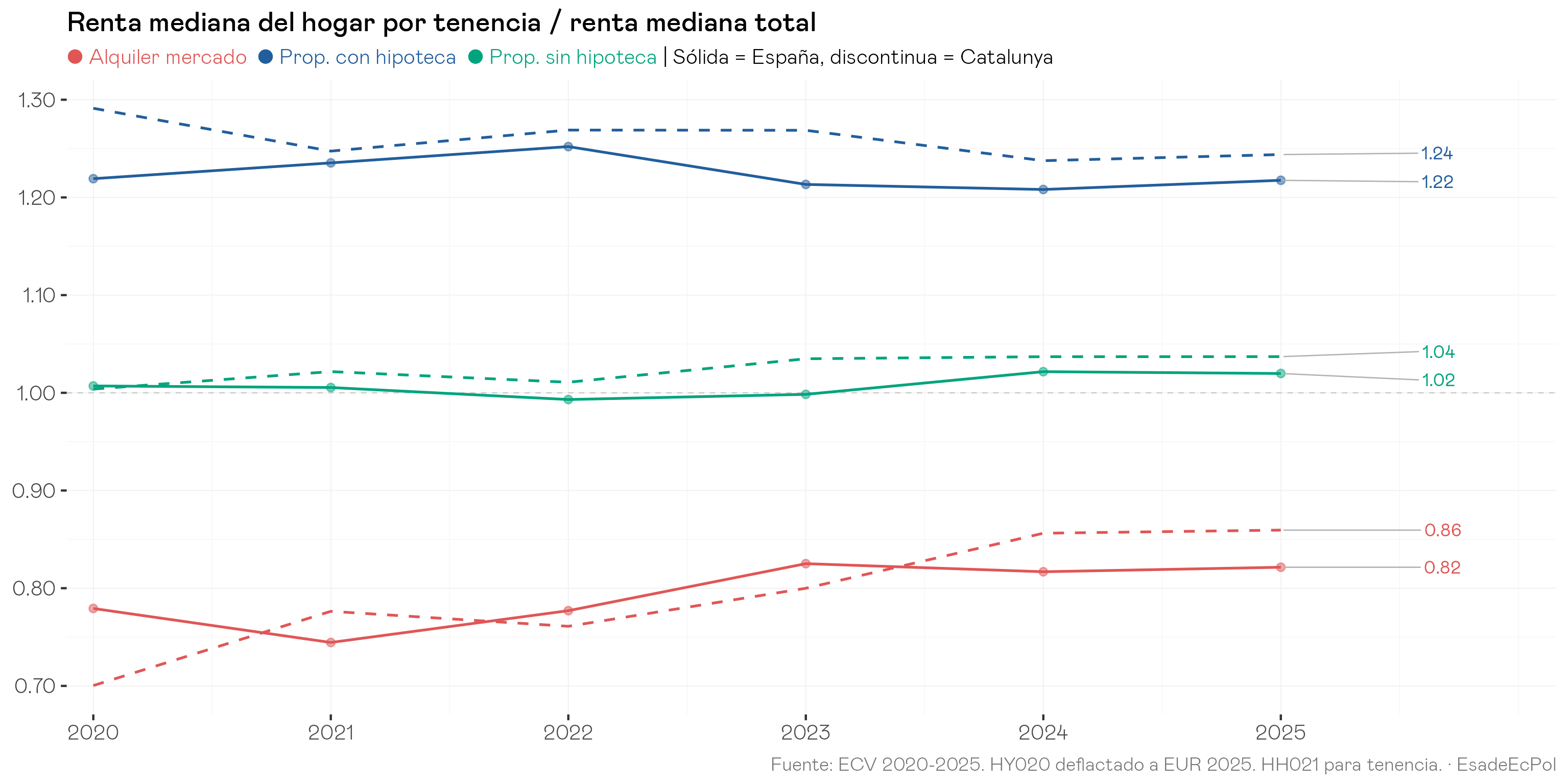
The following chart shows the median household income of each tenure status divided by the median income of all households (25-64). If income growth were proportional for all groups, the lines would show no variation. But a change can be seen, particularly in the market-rate rental category.

Between 2020 and 2025, the ratio of market tenants’ household income rises from 0.78 to 0.82 in Spain as a whole and from 0.70 to 0.86 in Catalonia. This means, for example, that Catalan tenants have gone from earning 30% less than the median to earning 14% less: a substantial narrowing in barely five years. The lines for owners with and without a mortgage, by contrast, remain stable above 1.0.
The relative income of Catalan tenants rises more steeply than the national figure, which indicates that rent caps coexist with a market whose tenants have ever higher incomes. And so, on the one hand, the mix changes and, on the other, prices are being capped not for those who need protection but for households that, in many cases, would not require it.
The composition of tenants is changing
Another way to verify the change in composition is to examine where market tenants sit in the income distribution of their autonomous community. Income quintiles are calculated each year within each autonomous community over the total population aged 25 to 64. They are a purely relative measure: if all incomes rose proportionally, the quintile composition of any group would remain stable. A change in that composition can only reflect a change in who belongs to the group.
And, indeed, in the last five years (and especially since 2022-2023) the percentage of the population in the lowest-income quintile has fallen from 37% to 32%, while the group of other forms of rental and rent-free accommodation has picked up.

The dynamic is even more pronounced in the autonomous community we use as a case study. The following chart shows the period 2020-2025 for Catalonia. In 2020, around 41% of people in market-rate rental belonged to the poorest quintile. By 2025, that proportion has fallen to 29%. And the grey line (rent-free accommodation and rental below market price): the concentration in Q1 rises from 28% to 41% in barely five years.

The simplest interpretation is that lower-income households do not disappear; they move from market-rate rental to family or informal arrangements. The ownership lines (with and without a mortgage) show less clear-cut dynamics in both charts. This shift is the statistical picture of residential exclusion. The households the regulation was meant to protect are precisely the ones leaving the regulated market.
The mirror image of the same phenomenon can be seen at the opposite end of the distribution. If market-rate rental were neutral in income terms, 40% of tenants would belong to the top two quintiles. In 2020, the figure was around 19% in Catalonia and 18% in Spain. By 2025, it has risen to 26% and 22% respectively. Market-rate rental is progressively taking in middle and upper-middle income households, and the process is more intense in Catalonia.

Catalonia is, let us recall, the autonomous community with the longest regulatory experience. That the selection process is more intense there is consistent with what the literature predicts: the supply restriction raises the threshold for access. This result can also be observed empirically in the recently published study by Ahern and Giacoletti (2026) on the impact of rent caps, in which they show that tenants with high purchasing power gained from the control while those on low incomes lost. The rent control mechanism proved clearly regressive among tenants.
In conclusion
The rental burden rate is an indicator conditioned by selection. It does not measure the affordability of the market but the outcome for those who pass the access filter. In a market with growing supply, the two converge. In a market with shrinking supply, they diverge: the indicator improves while access worsens.
This has direct consequences for the evaluation of rental regulation in Catalonia. If supply contracts and the tenant profile becomes richer, the burden rate of the average tenant will fall mechanically. A policymaker who uses this indicator as a measure of the policy’s success will be confusing selection with improvement. The data we have presented suggest that this is exactly what is happening.
To assess properly the impact of rent controls on affordability, the burden rate would need to be complemented with indicators that capture those who are left out of the market: the proportion of households with unmet demand, emancipation rates by income bracket, or the quintile composition of the tenant group that we present here. Without these complements, the public debate on housing will continue to rely on a thermometer whose temperature falls when the patient gets worse.
————
Methodological note
INE Living Conditions Survey, microdata. Population aged 25-64: most have completed their studies and are of prime working age. Market-rate rental = HH021=3. Burden = (HH060×12)/HY020. Household income (HY020) deflated by the CPI. Quintiles calculated within each autonomous community over the total aged 25-64. Catalonia as a case study because of the weight of renting, price pressure and regulation: almost 90% of citizens live in areas declared stressed
References
Ahern, Kenneth R. and Marco Giacoletti. 2026. The redistribution of housing wealth caused by rent control, Journal of Urban Economics, 152.
Diamond, Rebecca, Tim McQuade, and Franklin Qian. 2019. “The Effects of Rent Control Expansion on Tenants, Landlords, and Inequality: Evidence from San Francisco.” American Economic Review 109 (9): 3365–94
Khametshin, Dmitry, David López Rodríguez and Luis Pérez García. 2024. El mercado del alquiler de vivienda residencial en España: evolución reciente, determinantes e indicadores de esfuerzo. Documentos Ocasionales n.º 2432, Banco de España.
Kholodilin, Konstantin A. 2024. Rent Control Effects through the Lens of Empirical Research: An Almost Complete Review of the Literature. Journal of Housing Economics, 63: 101983.
Monras, Joan, and Jose G. Montalvo. 2023. The Effect of Second-Generation Rent Controls: New Evidence from Catalonia. Federal Reserve Bank of San Francisco Working Paper 2023-28.

Catedrático de Economía de la Universitat Pompeu Fabra. Profesor investigador de la BSE.
View profile
Related content